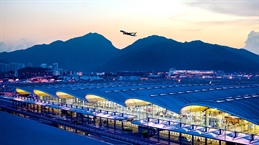
Hong Kong International Airport (HKG) remained the world's busiest cargo airport in 2025, according to newly released data from Airports Council International (ACI) World, which also showed that the global ranking of top cargo hubs was largely unchanged from the previous year.
The latest ACI World report showed HKG maintaining the top spot for air cargo volumes globally from 2024. The airport has been the consistent top cargo hub for 15 years nos, although it dropped to second in 2020 due to the wide-ranging impacts of the Covid-19 pandemic to global supply chains.
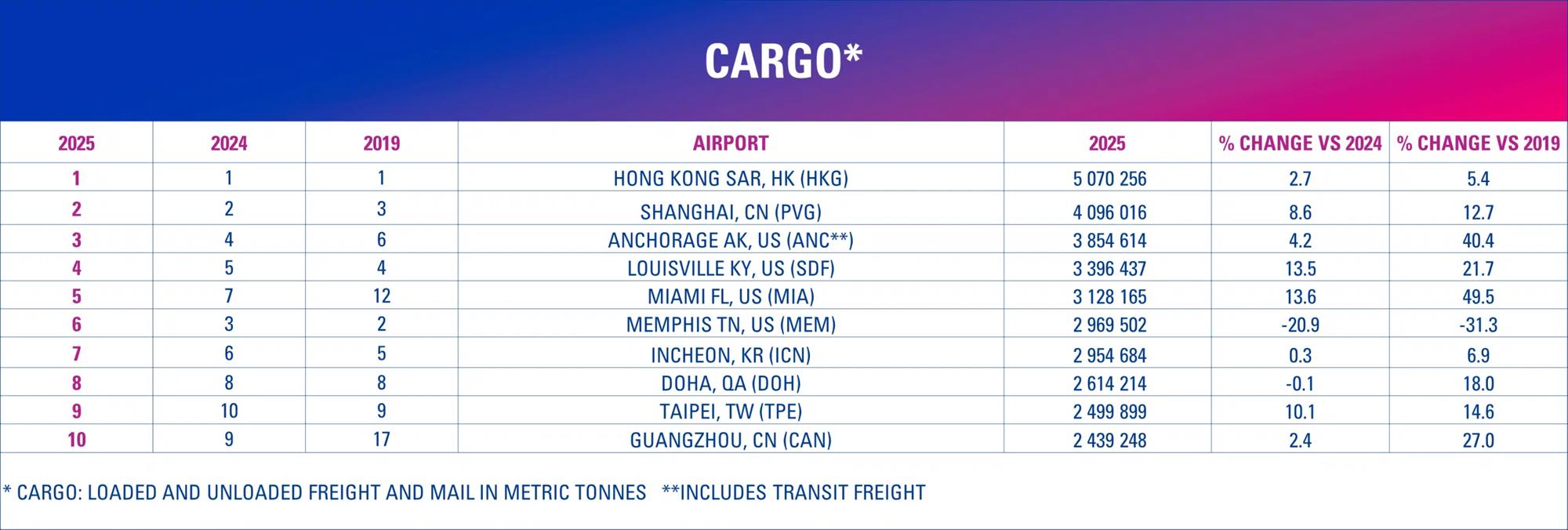
The global trade representative of the world's airport authorities said HKG remained the world's busiest air cargo hub in 2025, recording 5.07 million metric tonnes of cargo last year, up 2.7% from 2024 volumes. It's also 5.4% higher from the pre-pandemic volume at HKG.
"Air cargo volumes are estimated to have increased by 2.9% year-over-year (almost +8.8% versus 2019), to almost 128.9 million metric tonnes in 2025," ACI World said in its latest report, adding that air cargo traffic is more concentrated amongst the main airports.
(Source: ACI World)
Air cargo volumes in the top 10 airports represent close to 26% of global air cargo traffic.
In 2025, Shanghai Pudong Airport (PVG) took the second spot with 4.09 million metric tonnes of cargo, up 8.6% year-on-year, maintaining its position from 2024.
Anchorage Airport (ANC) in Alaska rose to third rank from fourth the previous year, recording 3.9 million metric tonnes of air freight, 4.2% higher than the preceding year. Louisville International Airport (SDF) — the primary hub of UPS Airlines took the fourth spot with 3.4 million metric tonnes of cargo, up 13.5% from 2024, one of the highest growth recorded among all the airports on ACI's top 10 busiest cargo hubs list for 2025.
Miami International Airport (MIA), the busiest airport in the US for international freight, was the world's 5th busiest air cargo hub, with 3.1 million metric tonnes of freight recorded in 2025 —13.6% higher than 2024 and a 49.5% jump from pre-pandemic levels in 2019.
Rounding the top 10 busiest air cargo airports list are Memphis International Airport (MEM)—home to the FedEx Express global hub, which saw a steep 20.9% drop in air cargo volumes (2.96 million metric tonnes), Incheon International Airport (2.95 million metric tonnes), Doha International Airport (2.6 million metric tonnes), Taiwan Taoyuan International Airport (2.5 million metric tonnes), and Guangzhou Baiyun International Airport (CAN) which recorded 2.4 million metric tonnes of air cargo.
"The increase is driven by strong e-commerce demand and supply chain adjustments," ACI World said.
In terms of aircraft movements, Chicago O’Hare International Airport (ORD) ranked 1st, followed by Atlanta International Airport (ATL), and Dallas/Fort Worth (DFW).
Global aircraft movements are estimated to be around 101.5 million in 2025, representing a gain of 2.3% from 2024 results or +0.2% vs 2019.
ACI World said the top 10 airports for aircraft movement represent 6.4% of global aircraft movements.
HKIA welcomes ranking
With HKIA once again topping global cargo rankings in 2025, Airport Authority Hong Kong (AAHK) said the milestone reflects years of coordinated effort and ongoing expansion across the city's logistics ecosystem.
"Full-year data for 2025 released today by Airports Council International ranks HKIA as the busiest cargo airport in the world. With cargo throughput reaching 5.07 million tonnes during the year, HKIA has topped the global ranking for the 15th time since 2010," ACI said.
Vivian Cheung, chief executive officer of Airport Authority Hong Kong (AAHK), welcomed ACI World's recognition of HKIA topping the global ranking for the 15th time since 2010.
"We are greatly honoured to retain our position as the world's busiest cargo airport. Thanks to the collective efforts of the air cargo community and strong support from various government departments, we continue to expand our capacity and enhance capability in handling high-value cargoes, e-commerce fulfillment, and cross-boundary transshipment, all being strategic and high growth segments," she said.
"Facing intense competition in the region and global economic uncertainties, we are redoubling our efforts to sharpen competitiveness and open new horizons for our cargo business."