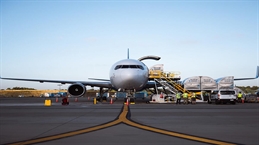
The International Air Transport Association (IATA) is urging regulators to ensure fairer airport slot access for air cargo, warning that despite its growing role in global commerce and crisis response, freight flights are increasingly pushed to the back of the queue.
Brendan Sullivan, IATA Global Head of Cargo, pointed out the importance of air cargo as a "cornerstone of world trade," noting that although just 1% of global trade by volume travels by air, but it accounts for 35% of the total value.
"In monetary terms, air cargo moves goods worth around US$8 trillion annually—an amount almost twice the GDP of Japan," Sullivan said.
Air cargo is also responsible for transporting vital, high‑priority shipments — from aircraft components and medical supplies to semiconductors and luxury items — with industries relying on its speed, safety and reliability to meet tight margins and critical deadlines.
The rise of e-commerce has turbocharged the demand for air cargo. Sullivan noted that today’s businesses, whether global conglomerates or small exporters, rely on just-in-time air freight to minimise storage costs and ensure swift market entry. This reliability enables even the smallest players to compete alongside industry giants.
"When we think of aviation, it's tempting to picture bustling terminals, and holidaymakers and business travelers jetting off in passenger aircraft that connect cities across continents. Yet, beneath this visible layer, a quieter but equally vital engine powers the global economy: air cargo," he said.
"Its influence is felt not only in commerce but also in how goods move, industries adapt, and societies respond to crises. But while air cargo matters more than ever to our modern way of life, it is increasingly at the back of the queue for airport slot coordination," he added.
In a recent statement, Sullivan noted that there's a vast ecosystem working behind the scenes to orchestrate this rapid movement of high-value goods and these networks ensure that products arrive where and when they're needed, often under immense time pressure.
Moreover, the role of air cargo extends beyond economics; it is also a social lifeline. During disasters, air cargo delivers urgent aid, medical supplies, and essentials, underscoring its significance to society.
"Despite its economic and social contributions, air cargo often faces significant hurdles in airport slot allocation," Sullivan said.
He pointed out that many airports, including Bogotá and Dubai, restrict cargo carriers to temporary ad hoc slots rather than granting historic allocations.
In China, cargo flights are confined to midnight–6 a.m. operations. And in major UK airports like Heathrow and Gatwick also deny historic slots to cargo, limiting their operational flexibility.
"Parking restrictions compound the problem," Sullivan said, adding that cargo operators may be limited to shorter parking durations than passenger flights—such as 10 hours versus 12 in Hong Kong—making scheduling more complex.
Local regulations, committee voting procedures (which often favour passenger airlines), and additional operational barriers like curfews, separation windows, and even outright bans in cities such as Mexico City or Mumbai further hinder cargo access.
"Stakeholder influence is arguably the main reason cargo is sidelined in slot allocation decisions, rather than a lack of awareness about its economic value," Sullivan said, adding that passenger airlines, with their frequent schedules and greater visibility, can exert more sway in coordination committees.
Infrastructure limitations and local rules also play a role, creating a labyrinthine environment that cargo operators must navigate.
"These disparities stem from local regulations, not global guidelines," IATA's global head of cargo further said.
Sullivan noted that the IATA Worldwide Airport Slot Guidelines (WASG) calls for fair, non-discriminatory, and transparent slot allocation, regardless of the type of operation being flown.
"Regulators, airport operators, and slot coordinators should review and align local rules with WASG principles," he said. "Ring-fencing slots for cargo is not the solution—it can lead to inefficiencies and unintended consequences. The focus should be on maximizing airport capacity for all users."
IATA noted that as global commerce evolves and the demand for rapid delivery intensifies, the value of air cargo will only continue to grow.
Sullivan said ensuring that cargo operators have fair access to airport slots is not just about economic efficiency; it's about meeting the needs of a changing world.
"The next time you receive a next-day delivery or see emergency aid arriving in a distant country, remember the quiet giant that makes it possible. Air cargo is more than a backstage player—it's a driver of opportunity, progress, and global connection."