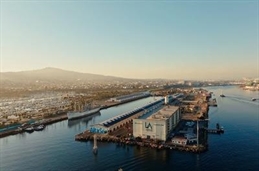
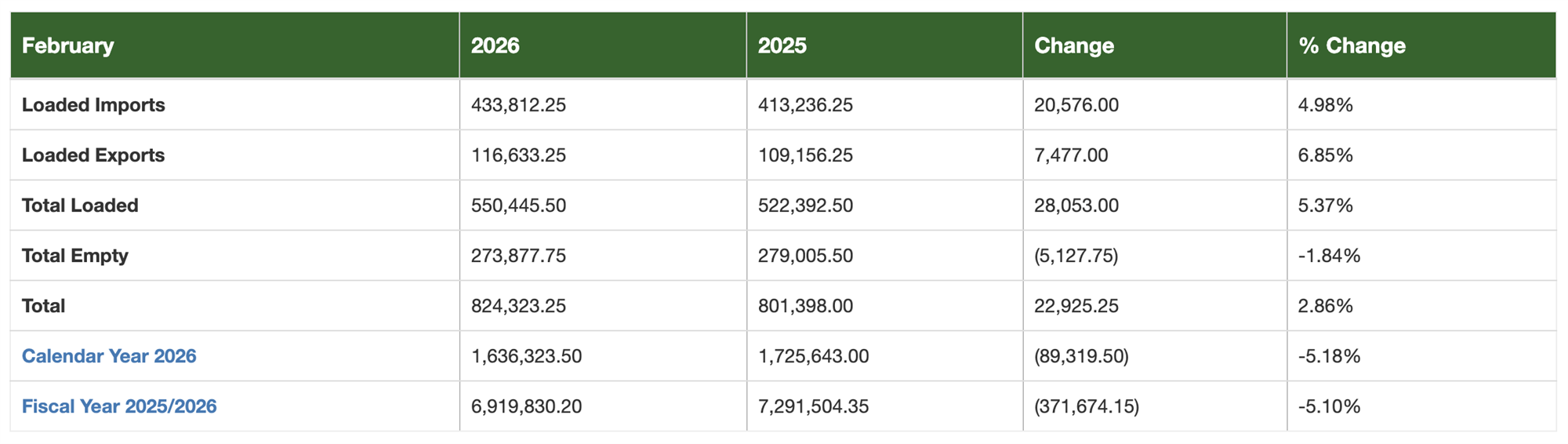
The Port of Los Angeles (Port of LA) processed 824,323 Twenty-Foot Equivalent Units (TEUs) in February, marking the second-busiest February in the port's history and an increase of 3% compared to last year.
Last month's volume was also higher than the 812,000 TEUs that the port handled in January as volumes dip resulting from a cautious restocking pace in comparison to a surge in early 2025 caused by importers acting before new tariffs.
(Source: Port of Los Angeles)
"Retailers and manufacturers brought in cargo ahead of the Lunar New Year holiday, when many factories paused production in Asia," said Gene Seroka, executive director at the Port of Los Angeles.
"As we head into our traditional slack season, it will be followed by some replenishment of inventories, particularly spring and summer fashion goods," he added, noting that the Port of LA will be prepared with efficient operations, terminal capacity and the world’s best waterfront workforce.
Seroka noted that while cargo volume remains steady, global developments are creating uncertainty across supply chains.
"With so many developments affecting supply chains — from the conflict unfolding in the Middle East to the Supreme Court tariff ruling and broader trade policy shifts — there’s real uncertainty across the industry right now," Seroka said.
"Even so, manufacturing flows serving the United States continue to move, and we're not seeing disruption to U.S.-bound cargo today."
February 2026 loaded imports totaled 433,812 TEUs, 5% higher than last year. Loaded exports reached 116,633, an increase of 7%.
Port of LA processed 273,878 empty container units, 2% less than last year.
Two months into the year, Port of LA has handled 1,636,324 TEUs, 5% less than last year.
Port of LA is one of North America's leading trade gateway. In 2025, the Port handled a total of 10.2 million container units, sustaining its top rank among U.S. ports.