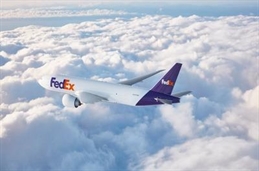
FedEx introduced sustainable aviation fuel (SAF) at two more U.S. airports towards the end of last year: Dallas Fort Worth International Airport (DFW) and John F. Kennedy International Airport (JFK).
With these two additional deployments, FedEx began using blended SAF at a total of five major U.S. airports in 2025. Combined, these agreements secure the equivalent of 5 million gallons of neat SAF.
"Expanding SAF use by FedEx to include our operations at DFW and JFK caps off a successful year of SAF deployments coast-to-coast," said Karen Blanks Ellis, chief sustainability officer and vice president of Environmental Affairs, FedEx.
"While we know there remains work ahead to procure more SAF and to continue to educate our stakeholders about how alternative fuels fit into our overall aviation sustainability strategy, we are proud of our steps forward in 2025."
Through an agreement with fuel provider World Fuel Services (WFS), FedEx will receive a total of two million neat gallons of SAF across the two airports, to be delivered as a minimum 30% blend.
With the fuel deliveries to DFW that began in December 2025, FedEx became the first airline—cargo or passenger—to begin purchasing SAF at that airport outside of a pilot project.
SAF outlook in 2026
Despite air carrier demand for SAF as part of industry sustainability goals, the International Air Transport Association (IATA) is projecting that the growth rate of SAF production worldwide will slow down in 2026.
"When SAF policy focuses on the air carriers and demand side of the equation, there is a risk of not concurrently building up the actual alternative fuel supply needed to comply and make progress on emissions reduction goals," said Blanks Ellis.
"To meet the industry"s demand for SAF—both mandated and voluntary—concerted support and encouragement for increased SAF production must be part of the policy framework."
Along with increased procurement of alternative fuels to power its global fleet of more than 700 aircraft, FedEx has long pursued other efficiency improvement projects like aircraft modernization and fuel savings initiatives.
After achieving the goal of a 30% reduction in aircraft emissions intensity from a 2005 baseline in FY24, FedEx expanded the goal to a 40% reduction by 2034.