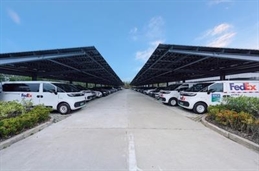
Federal Express Corporation (FedEx) is strengthening its sustainability efforts across the Asia Pacific with the launch of a new solar installation at the FedEx Shanghai International Express and Cargo Hub.
This marks a significant milestone in the company's commitment to advancing sustainable logistics infrastructure and makes FedEx the first and currently the only logistics and freight company at Shanghai Pudong International Airport cargo area to generate on‑site solar energy.
The installation leverages existing parking facilities at the Shanghai Hub, where more than 4,000 square meters of solar panels have been deployed.
The system is expected to generate an average of 743,000 kilowatt‑hours of electricity annually.
FedEx noted that compared with equivalent coal‑fired power generation, this renewable energy output is projected to avoid nearly 417 metric tons of carbon dioxide emissions each year, while reducing about 2.1 tons of particulate matter and 4.21 tons of sulfur dioxide.
The electricity produced will primarily support office operations at the hub, significantly increasing the share of clean energy in the company's day‑to‑day activities.
The Shanghai solar installation is the latest addition to a growing list of renewable energy projects supporting FedEx facilities across Asia Pacific.
Since November 2022, the FedEx Incheon Gateway in South Korea has generated clean electricity from 2,400 rooftop solar panels, meeting about 19% of the facility’s monthly energy needs. The building also uses 100% LED lighting, delivering annual energy savings of more than 22,000 kW hours. In Beijing, the rooftop solar array at the FedEx North China Regional Headquarters became operational in 2023.
Since January 2025, more than 50 percent of the electricity used at the FedEx South Pacific Regional Hub in Singapore has been supplied by on‑site solar generation, which also supports the company's local electric vehicle fleet.
"Asia Pacific is one of the world's most dynamic trade corridors, and the future of its growth depends on a more resilient and sustainable logistics backbone," said Salil Chari, president of FedEx Asia Pacific.
"We are investing in infrastructure that accelerates decarbonization at scale. The Shanghai solar installation is another example of how we are embedding clean energy directly into our operations, building an efficient, future‑ready network that serves our customers while advancing environmental progress across the region."
To date, FedEx has generated more than 31 GWh of on- and off-site solar energy across over 30 locations worldwide. The company continues to advance energy conservation, emissions reduction, and low-carbon operations through a combination of emerging technologies, digital innovation, and community sustainability initiatives, including vehicle electrification, innovative digital tools, emerging technologies, and sustainability-focused community programs.
FedEx said its global electric vehicle fleet is currently more than 8,000 vehicles, with growing adoption across the region. Electrification in China has surpassed 25% while EV operations continue to expand in Japan, Korea, New Zealand, Thailand and Hong Kong. Recent additions include the first fleet of six electric cargo vans in Korea, serving high‑density routes in Seoul and Busan, as well as new EVs in Singapore.