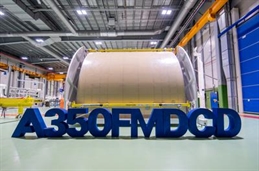
Airbus has completed the manufacturing and assembly of the first main deck cargo door for the A350F freighter at its facility in Illescas, Spain. The component has been delivered to the Final Assembly Line (FAL) in Toulouse, where it will be integrated into the fuselage of the first test aircraft and undergo testing in the coming weeks.
Airbus said is manufacturing two A350F aircraft for flight testing from 2026 to 2027.
The European aerospace company said the A350F main deck cargo door is the largest in the industry. It features a 4.5-metre cut-out width and a 4.3-metre tall opening, and is designed to make loading and unloading operations easier, faster, and safer.
It is located in the rear fuselage to maintain an optimal centre of gravity during loading, the door is made from composite materials and features an electrical open/close actuation system.
The Airbus plant in Illescas is one of the company's leading centres for the manufacturing of large-scale, complex composite surfaces. It manufactures the skins and assembles the door before it is delivered for its integration into the fuselage.
As part of the pre-series production process the first main deck cargo doors will be installed in Toulouse.
Airbus said once serial production starts, the main deck cargo door will be delivered from Illescas to Hamburg for integration into the aft fuselage and for the installation of the actuation systems. From there, that section of the fuselage will be transported to the FAL in Toulouse following the Airbus production process.
"This milestone demonstrates Spain's key role in the production of our commercial aircraft, including the A350F programme. Delivering the first main deck cargo door is the result of years of preparation and extensive teamwork, showcasing the deep expertise and technical maturity that Illescas plant has refined over decades in composite materials," said Ricardo Rojas, president of Airbus' Commercial Aircraft business in Spain.
The A350F, developed as a next‑generation freighter, is built to meet rising demand in the global air cargo market. With a range of up to 8,700 kilometres and a payload capacity of 111 tonnes, the aircraft is intended for long‑haul international operations. More than 70% of its structure uses advanced materials, making it 46 tonnes lighter than comparable models.
The aircraft is powered by Rolls‑Royce Trent XWB‑97 engines and is expected to deliver up to a 20% reduction in fuel burn and carbon emissions compared with previous‑generation freighters offering similar payload‑range performance. It is also the only freighter that fully complies with ICAO’s 2027 CO₂ emission standards. At entry‑into‑service, the A350F will be able to operate with up to 50% Sustainable Aviation Fuel, with Airbus targeting 100% capability by 2030 across its fleet.
At the end of March 2026, the A350F had registered 101 orders from 14 customers.