The Iran war has amplified uncertainty in the container shipping outlook, with BIMCO that the sudden halt of Strait of Hormuz transits and the wider geopolitical fallout are clouding an already fragile market shaped by shifting U.S. tariffs.
In its latest Container Shipping Market Overview & Outlook, the world's largest direct-membership organization for shipowners, charters, brokers, and agents, representing over 60% of the world's merchant fleet by tonnage, noted that transits through the Strait of Hormuz have "effectively stopped" since attacks on Iran began on February 28, severing Persian Gulf ports from global container services.
"Following the start of attacks on Iran on February 28, transits through the Strait of Hormuz have effectively stopped, severing Persian Gulf ports from global container services," said Niels Rasmussen, chief shipping analyst at BIMCO.
BIMCO estimates that the loss of Hormuz transits has halted the movement of around 3% of global container volumes, directly affecting roughly 5% of global ship demand. Because many vessels serving Persian Gulf ports also call at Pakistan and India, nearly 10% of the global fleet has been disrupted.
The conflict compounds uncertainty stemming from U.S. trade policy. The U.S. Supreme Court has ruled that most import tariffs imposed in 2025 and early 2026 were unlawful, requiring collected fees to be refunded.
In response, President Donald Trump introduced a temporary 15% across‑the‑board tariff, set to expire after 150 days unless extended by Congress.
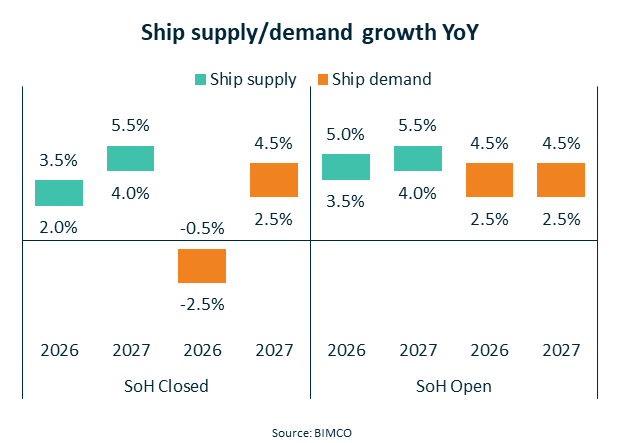
Given the unpredictability of when Hormuz transits might resume, BIMCO has developed two forecast scenarios: one assuming the strait remains effectively closed indefinitely (SoH Closed) and another assuming an imminent reopening (SoH Open).
"With the exception of ships currently stuck in the Persian Gulf, ship supply growth is mostly unimpacted by the lack of transits through the Strait of Hormuz whereas demand is expected to fall by 5% in 2026. However, we find it likely that the ships no longer serving Persian Gulf ports will be made idle, laid up or used to cover contingencies rather than redeployed in other trade lanes. What appears as a substantial weakening of the global supply/demand balance might therefore not significantly impact other trade lanes," Rasmussen said.
Beyond the Gulf, the war has heightened perceived risks in the Red Sea due to Iran's ties with the Houthis. Early attempts by carriers to return to normal Suez Canal routings have been reversed, further delaying any full restoration of pre‑war networks.
Even if Hormuz transits resume soon, BIMCO expects outlook uncertainty to persist. Its ship demand forecast spans a two‑percentage‑point range, while ship supply projections include both minimum and maximum scenarios.
The lower supply estimate assumes average sailing speeds will gradually fall back toward 2023 lows.
"Whether the Strait of Hormuz remains effectively closed or not, we expect a slight weakening of the global supply/demand balance in 2026 and 2027. However, if transits do not resume, liner operators will face substantial extra costs due to higher oil prices while cargo volumes will be reduced," Rasmussen added.