
Global shipping schedule reliability declined in October after months of steady improvement, according to a new a new Sea-Intelligence analysis, likely due to increased vessel delays and operational volatility after several months of stability.
In October, global industry schedule reliability declined month-on-month (M/M) by 3.5 percentage points to 61.4% from the 6.5% recorded in September 2025.
Sea-Intelligence noted that this is only the second major M/M decline in 2025 and comes after three consecutive months of stable global schedule reliability.
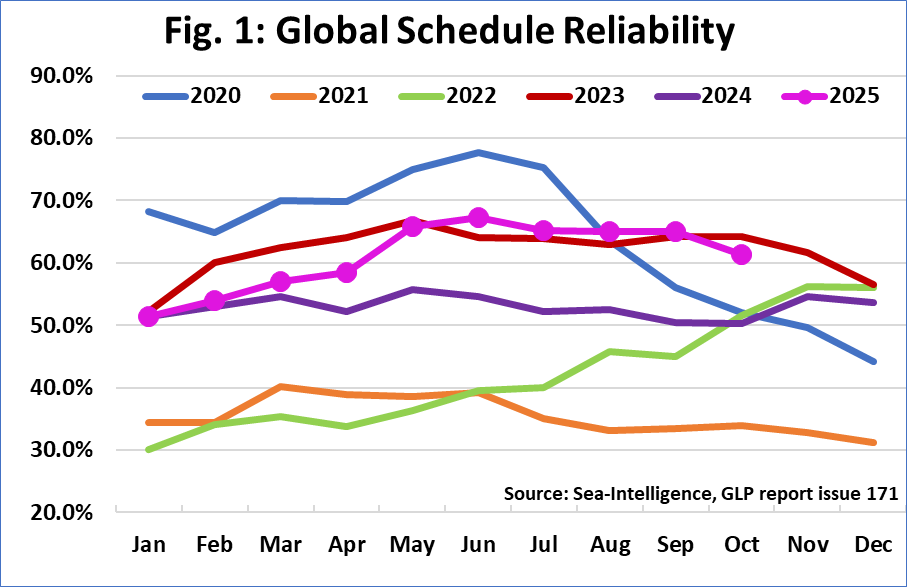
On a year-on-year (Y/Y) level, schedule reliability was up 11.1 percentage points.
The Global Liner Performance (GLP) report, covers schedule reliability across 34 different trade lanes and 60+ carriers.
In October, the average delay for LATE vessel arrivals increased M/M by 0.04 days to 4.98 days.
On a Y/Y level though, the October 2025 figure was -0.87 days lower.
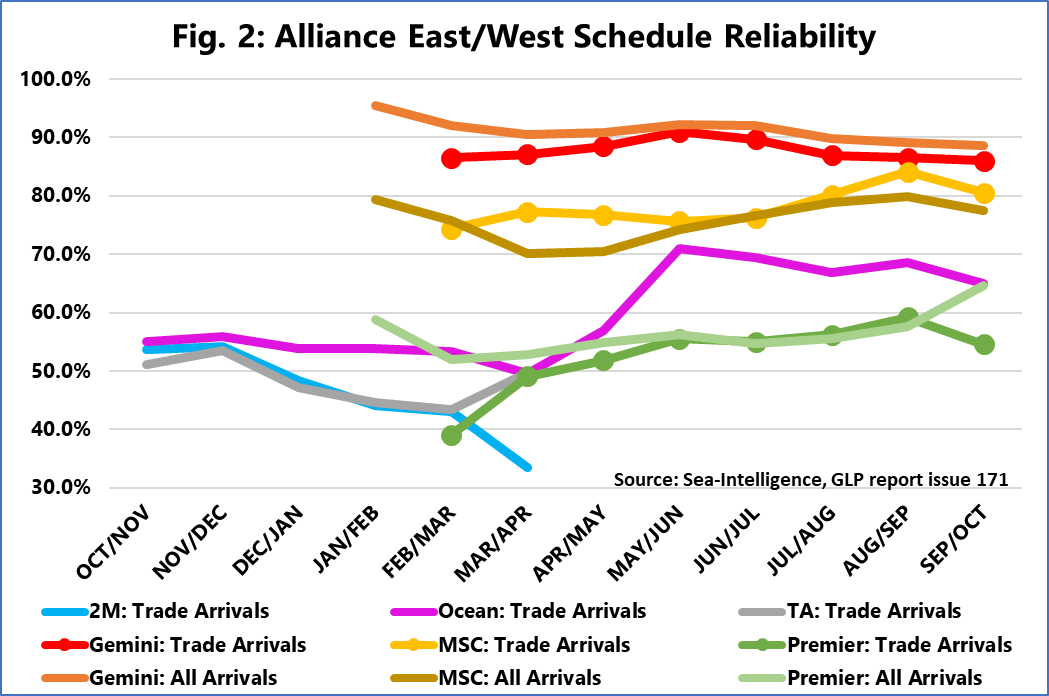
"Traditionally, alliance scores are based on just the arrivals in destination regions, but as that metric was not available for the new alliances in February, we introduced a new measure, based on all arrivals, including the origin region calls on the East/West trades," said Alan Murphy, CEO, Sea-Intelligence.
"We continue to present both measures, "All arrivals" which is comparable to the February measure, and "Trade arrivals", which is comparable to the "old" alliances. When the new alliances are fully rolled out, these two measures will converge," he added.