Aviation article(s)


Rating
ASIA-PACIFIC, MIDDLE EAST TO CONTINUE TO LEAD GLOBAL AIR CARGO GROWTH THROUGH 2028
December 11, 2025
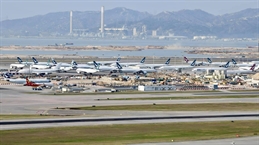
Asia Pacific and the Middle East are expected to lead global air cargo growth in the next three years, as supply chain reshuffling continues, according to Airports Council International Asia-Pacific & Middle East (ACI APAC & MID),'s latest outlook on the air freight industry.
The trade body representing over 600 airports, highlighted stabilising demand, recovering supply chains, and long-term growth until 2028 in its newly-released outlook on air cargo performance across the region.
The updated version of ACI APAC & MID's short term forecast 2025-2028, projects Asia-Pacific air cargo volumes to grow 4.3% CAGR through 2028, while the Middle East is expected to expand at a 3.3% CAGR.
"Asia-Pacific continues to lead global air cargo, driven by its strong manufacturing base, particularly in semiconductors and electronics, along with expanding cross-border e-commerce networks and its significant demographic scale," ACI said in a statement, adding that together, these structural advantages are expected to sustain the region's cargo leadership well into the future.
On the other hand, the Middle East's location at the crossroads of Europe, Asia, and Africa has strengthened its position as a major hub for air cargo, supporting trade and attracting global logistics players.
Ongoing economic development, large urban projects, and rising demand for advanced logistics services are further accelerating the region's growth in global air freight.
Stefano Baronci, director general of ACI Asia-Pacific & Middle East, said the resurgence of cargo, particularly significant in the first 10 months of the year in Asia-Pacific, powered by e-commerce and manufacturing shifts, highlights the region's underlying economic resilience.
"Despite geopolitical tensions and trade uncertainties, over the next three years we expect Asia-Pacific to continue to play the lion’s share in terms of cargo growth."
"To prepare for this, over the next 10 years, airports in both Asia-Pacific and Middle East will invest extensively to add 71 million tonnes of additional cargo capacity. This growth trajectory requires supportive policies and coordinated planning across the cargo supply chain," he added.
Asia-Pacific outlook 2025-2028
South Asia is projected to grow at 5.5% CAGR through 2028, boosted by India's strong economic outlook. The forecast shows South-Eastern Asia growing at 5.2%, driven by its rising role in China+1 manufacturing, while China is projected to grow at 4.4%, supported by strong cross-border e-commerce.
Eastern Asia is expected to grow 2.6% CAGR to 2028, supported by steady export recovery.
Oceania is projected to achieve a CAGR of 3.7%, indicating a steady increase in demand, driven by the continuous expansion of e-commerce, strong investment, and steady consumer demand.
ACI said the Middle East air cargo market is projected to continue its upward trajectory in the near term. Cargo volumes are forecast to grow at 3.3% CAGR from 2025 through 2028, outpacing some other regions like Europe and the United States in terms of percentage growth.
It noted that Gulf airports are investing heavily through 2028, adding cargo terminals, upgrading technology, and expanding cool-chain capacity to support faster, more efficient cargo handling.
Surging online retail and cross-border e-commerce, especially flows from Asia, are boosting demand. Operators are expanding express networks and automation to manage rising parcel volumes.
Adoption of AI-enabled cargo management, digital booking platforms, and automated systems is also strengthening efficiency and supporting the region's projected 3.3% annual cargo growth.
Meanwhile, IATA pointed out that while growth prospects remain positive, geopolitical tensions and trade uncertainties pose significant risks to the region's air cargo market.
"Conflicts, airspace restrictions, and shifts in regional security dynamics, alongside trade policy changes and tariffs, could disrupt key corridors and affect cargo flows," ACI said.