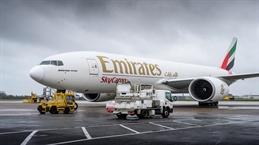
Emirates SkyCargo is gearing up for a major growth push in 2026, wrapping up the year with a strengthened fleet strategy, new partnerships and expanded digital capabilities as it prepares for the delivery of up to 10 Boeing 777Fs by December.
The carrier said the investments made over the past 12 months have positioned it to meet rising global demand and support the next phase of its network expansion.
Badr Abbas, divisional senior vice president, Emirates SkyCargo, said in 2025, the cargo arm of the world's largest international airline, "built the runway for what comes next."
"We strengthened the core pillars of our business by expanding our network and innovating with our product portfolio and operations to deliver what our customers need today – and tomorrow."
"2026 is set to be a pivotal year for our fleet expansion, with the expected delivery of up to 10 Boeing 777Fs by December, fuelling our next era of growth. This influx of capacity unlocks opportunities for network and scheduling expansions, offer more flexibility to scale our solutions and enable us to deliver even greater value across our global network," Abbas said.
21 freighters by end 2026
At the start of 2025, the first of Emirates SkyCargo's Boeing 777Fs were delivered with another two in the following months, allowing the airline to retire older aircraft and deliver on its commitment to operate one of the youngest fleets in the sky.
The fleet currently stands at 11 Boeing 777Fs and 5 wet-leased Boeing 747s. Meanwhile, the first Emirates' passenger aircraft entered the conversion programme, with the view to start operations as a fully-fledged freighter in 2026.
By the end of next year, Emirates SkyCargo said in a statement that it aims to operate a fleet of at least 21 freighters, adding significantly more cargo capacity to current operations.
Emirates SkyCargo expanded its freighter network in 2025, adding services to eight new destinations: Copenhagen, Narita, Bangkok, Mumbai, Beirut, Conakry, Phnom Penh (KTI) and Hanoi. The carrier also increased frequencies to high‑volume markets including Guangzhou, Shanghai and Johannesburg. Hanoi, introduced late in the year, was quickly increased to four weekly flights to meet demand. By the end of 2025, the airline’s freighter network covered 42 destinations across six continents.
Throughout 2025, Emirates SkyCargo strengthened its network of over 180 global interline partners, inking new agreements to expand its global footprint.
In February, the airline signed with Africa-based Astral Aviation and then in April, with Southeast Asia's Teleport, to create seamless connectivity into primary, secondary and tertiary airports in two regions that are burgeoning with trade opportunities. The airline also continues to reinforce its existing strategic partnerships with global airlines such as Air Canada, United and Virgin Atlantic.
Emirates SkyCargo noted that even as it draws up plans for its all-new facility at Al Maktoum International Airport (DWC), it continued to invest in its current operations to deliver peak performance.
The airline upgraded its on-road fleet by taking delivery of 40 Euro 6 trucks from MAN Trucks, bringing the latest low-emissions and driver-centric technology to the region.
"By Q1 2026, the fleet will be bolstered with the delivery of five hydrogen-powered trucks, marking a key milestone in the company's gradual transition to alternate fuel vehicles," Emirates SkyCargo said.
Exploring next-gen cargo delivery solutions, Emirates SkyCargo and LODD Autonomous will collaborate on the development and feasibility of VTOL (Vertical Take Off and Landing) aircraft for first and last mile delivery throughout 2026.
The rise in digital bookings – coupled with the decline in manual bookings – continued to grow throughout the year, as more customers opted for seamless and efficient processes.
Emirates SkyCargo said by December 2025, almost 80% of all shipments on Emirates SkyCargo are booked digitally, driven predominately by eSkyCargo, and followed by the third-party digital marketplaces where the airline is present and direct customer API integrations.
Digitising other critical cargo processes, Emirates SkyCargo said it became the first carrier in the region to adopt PayCargo's solution, introducing instant payments via credit card or direct debit, as opposed to the traditional and inefficient cash transactions.
Looking ahead to 2026, the airline will explore further enhancements to its digital toolbelt, such as adding new features and products that refine the customer journey.
Expanded product solutions in 2026
Emirates SkyCargo said 2025 saw the landmark launch of Emirates Courier Express, the airline's door-to-door delivery solution. It added that within months, the solution had already scaled to launch in Australia and Germany, with a roadmap of upcoming launches into the world's largest economies throughout 2026.
To date, the solution has delivered over 50,000 packages with an average delivery time across its network of 3 days, and an average of 1 day between the UK and UAE.
Emirates SkyCargo also launched the Aerospace and Engineering vertical, featuring an optimised AOG service and an all-new Aircraft Engines offering, meticulously balancing speed and security into specialised solutions.
Emirates SkyCargo said it has recorded a 100% increase in the movement of individual engines, compared to the same time period last year, with demand continuing to grow – something the airline will be better placed to serve with the future aircraft deliveries.
Emirates SkyCargo's Fresh solution, dedicated to the movement of food, flowers and other perishables and the airline's biggest vertical by tonnage, grew by 10% uplifting an additional 25,700 tonnes in comparison to 2024 – the equivalent of 275 million apples.
It noted that with the UAE's Comprehensive Economic Agreements (CEPAs) coming into effect, the airline will continue to keep perishables moving from farm to table in as little as 24 hours.
The carrier also saw a surge in demand for critical and personalised patient treatments such as clinical trials or cell and gene therapies, with transports recording a 54% increase in volume on Vital, the airline's dedicated white glove service for the most sensitive pharmaceutical shipments.
Emirates SkyCargo said it continues to invest in its infrastructure, technology and processes to reinforce its reputation as an undisputed market leader in the life sciences and healthcare vertical, moving 2,000 tonnes of pharma every week.
The increased volume of mobile phones and other personal electronic devices being manufactured in Vietnam and India also drove a 30% uptick in the airline's Secure solution and the carrier met the demand with a mixture of freighter services and SEA-AIR solutions.
"In 2026, the airline will build on this strong foundation to deliver on its long-term strategy which includes doubling its current capacity, adding 20 new freighter destinations to its network and shaping the future of the industry with smart, digital-first products and services," Emirates SkyCargo said.