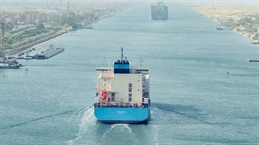
Maersk has resumed transits through the Red Sea after nearly two years of suspended operations triggered by security threats in the region, restoring a key link in its India–Middle East–US service network.
The Danish shipping line, one of the largest in the world, said it is implementing a "structural return" to the trans-Suez route for all Maersk MECL service from January 15.
The MECL service is solely operated by Maersk, and connects the Middle East and India with the US East Coast.
It follows the Jebel Ali – Pipavav – Nhava Sheva – Salalah – Algeciras – Newark – Charleston – Savannah – Houston – Norfolk – Newark – Algeciras – Salalah – Jebel Ali port rotation.
"This decision follows a continued stabilisation of conditions in and around the Red Sea, including the Suez corridor, as well as improved stability and reliability in the region, allowing us to return to the service pattern originally designed to provide our customers with the most efficient transit times," Maersk said in a customer advisory on January 15.
Maersk noted that it will continue to monitor the security situation in the region very closely, and any alteration to the MECL service will remain dependent on the ongoing stability in the Red Sea area and the absence of any escalation in regional conflict.
"The safety of crew, assets, and customers’ cargo remains the highest priority. Maersk has contingency plans in place should the security situation deteriorate, which may necessitate reverting individual MECL sailings or the wider structural change of the MECL service back to the Cape of Good Hope route," the ocean carrier added.
Return to Maersk's original service pattern
Maersk said that as part of its structural return to the trans‑Suez route for all vessels on the MECL service, the Cornelia Maersk (voyage 603W), departing Jebel Ali on January 15, 2026, will mark the first westbound sailing to resume the trans‑Suez routing.
The Maersk Detroit voyage 602E, departing North Charleston on January 10, 2026, will be the first eastbound sailing to use the Trans-Suez route, with all subsequent sailings following this routing.
"The Trans-Suez route is the fastest and most efficient route for MECL, and you will benefit from a transit time that is one week faster, expected from Maersk Kensington voyage 607W (Westbound) and onwards, and on Eastbound sailings from the Maersk Detroit voyage 602E and onwards," Maersk told its customers.
In order to offer more sufficient time to adjust supply chains and logistics planning, the shipping line said sailings prior to the Maersk Kensington and the Maersk Detroit will not see any changes in transit times.
"Please note that as the Clementine (voyage 606W) and the Kensington (voyage 607W) will be arriving to Newark in the same week, there may be some temporary impacts to imports to the US via MECL. This is not expected to generate congestion," it added.
Meanwhile, Maersk said it does not have any additional structural changes to announce to its East–West network at this time, adding that it will communicate promptly and transparently should the situation evolve.
Halt to Red Sea transits in 2024
Major container carriers, including Maersk, halted Red Sea transits in early 2024 after Yemen‑based Houthi forces began targeting commercial vessels in the region. The escalation followed the outbreak of the Gaza conflict, with attacks involving missiles, drones, and attempted boardings concentrated around the Bab el‑Mandeb strait. The situation intensified after the December 30, 2023 attack on the Maersk Hangzhou, prompting Maersk on January 2, 2024 to pause all Red Sea and Gulf of Aden transits “until further notice.”
Other global carriers implemented similar suspensions, rerouting ships around the Cape of Good Hope and adding significant time and cost to Asia–Europe and Middle East–US services.
After nearly two years of diversions, Maersk began cautiously testing the corridor again. The company completed a successful trial transit through the Bab el‑Mandeb and Suez Canal in late 2025, followed by another confirmed safe passage in January 2026, when the Maersk Denver completed a westbound transit without incident.
These controlled sailings were conducted to evaluate whether security conditions had improved enough to support a broader operational return.