Asia Pacific carriers saw continued rise in air cargo demand over the past year, with resilient supply chains and strong e‑commerce flows helping offset the impact of new tariffs and geopolitical uncertainty.
Traffic figures released by the Kuala Lumpur-based Association of Asia Pacific Airlines (AAPA) showed "robust growth" in cargo markets, underpinned by resilient economic conditions, even as trade and geopolitical uncertainties remained elevated.
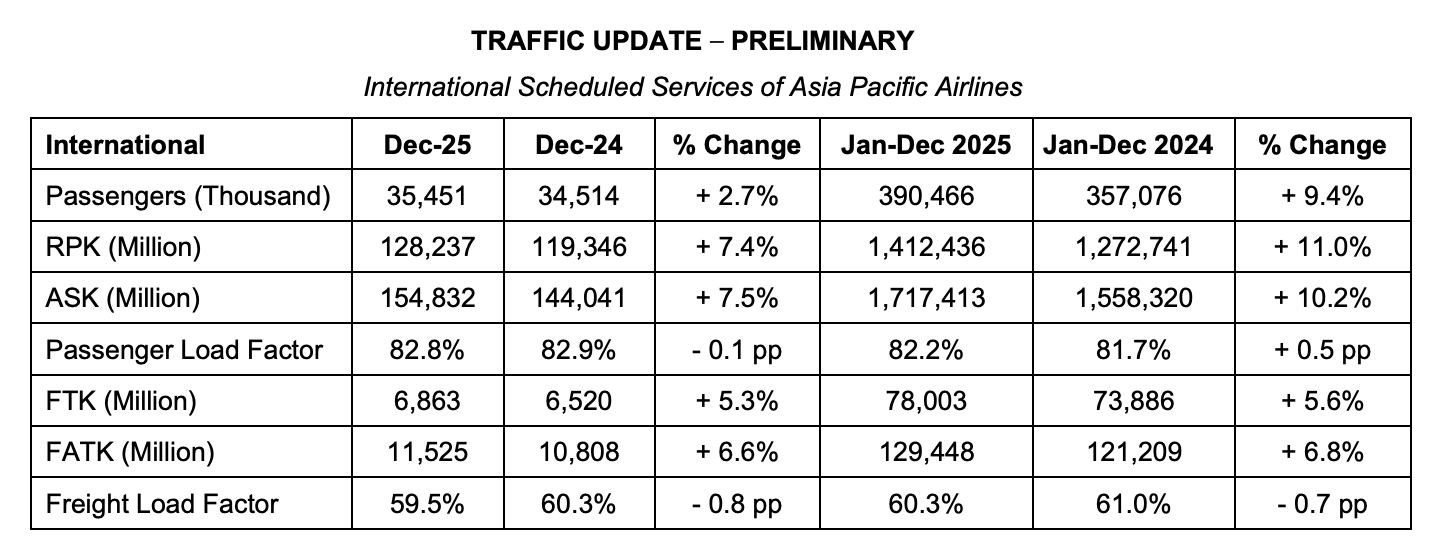
International air cargo demand — measured in freight tonne-kilometers (FTK) — was up 5.6% year-on-year in 2025 to 78 million metric tonnes from the 73.9 metric tonnes during the same January-December period in 2024.
For December alone, international air cargo demand was up 5.3% to 6.9 million metric tonnes compared to the 6.5 million metric tonnes recorded in December the preceeding year.
December's performance was steady from November's 6.91 million metric tonnes of cargo and higher than October's 6.64 million metric tonnes and September's 6.4 million metric tonnes. In August, Asia Pacific airlines transported 6.5 million metric tonnes of cargo.
In July, carriers in the Asia Pacific carriers moved 6.8 million tonnes and it reached 6.6 million tonnes in June. In May, carriers transported 6.42 million tonnes, and in April, they moved 6.24 million tonnes of cargo.
(Source: AAPA)
"Against a challenging operating environment with the introduction of tariffs on Asian and major global economies, air cargo markets benefited from the rapid adaptation of global supply chains," said Subhas Menon, director-general at AAPA.
"As a result, Asia Pacific airlines recorded a 5.6% increase in international air cargo demand, as measured in freight tonne kilometres (FTK), in 2025," he added.
For 2025, Menon noted that the continued expansion in belly-hold space contributed to a 6.8% increase in offered freight capacity, leading to a 0.7 percentage point decline in the average international freight load factor to 60.3% for the year.
"Asia Pacific airlines recorded a 5.6% increase in international air cargo demand in 2025, building on the strong 14.9% growth achieved in 2024. The region’s carriers demonstrated agility in responding to changes in trade policies and market dynamics, while benefiting from continued growth in e-commerce demand and intermediate goods flows from manufacturing hubs across the region," the AAPA chief said.
Looking ahead, Menon said the industry enters 2026 with a generally positive outlook, even as some risks remain.
"Air cargo demand is also expected to continue growing, but may be weighed down by trade tensions in the global economy."
"At the same time, Asian airlines continue to face inflationary pressures on operating costs, partly reflecting ongoing supply chain disruptions. Overall, Asia Pacific airlines remain focused on active cost management, investments in digital capabilities, and network adjustments in response to market changes, as they navigate ongoing uncertainties while delivering sustainable, long-term growth," the AAPA chief added.