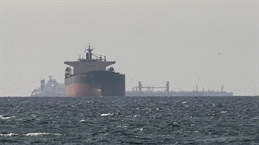
A sustained closure of the Strait of Hormuz could leave more than 200,000 TEU of deep‑sea container capacity effectively trapped in the Persian Gulf, sharply amplifying the impact of the chokepoint disruption on global supply chains, according to new analysis from Sea‑Intelligence.
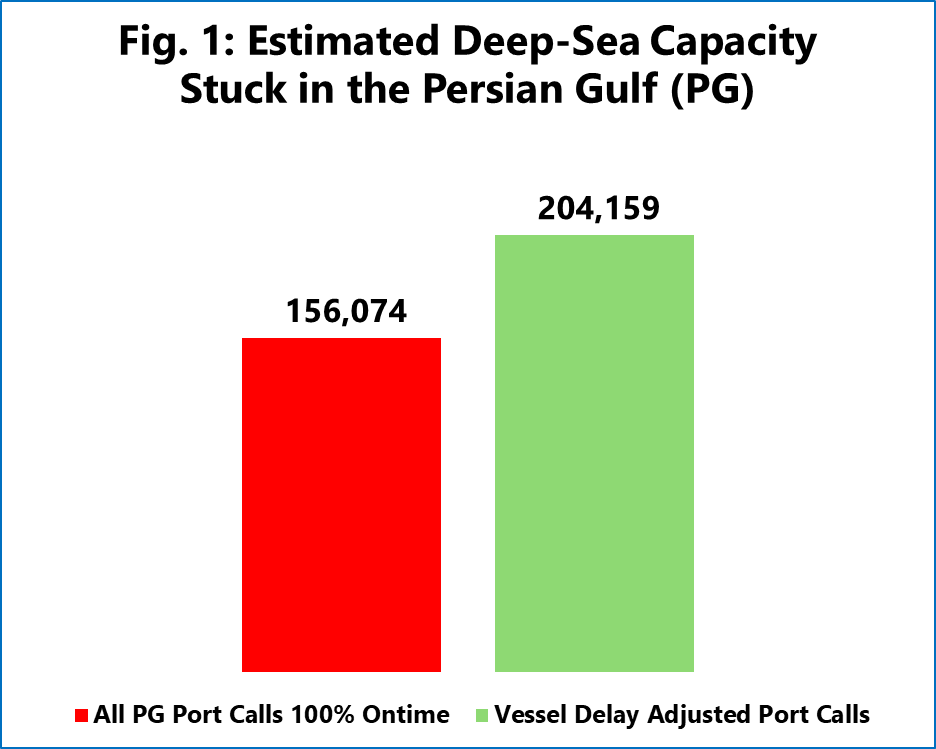
In its latest Sunday Spotlight report, the consultancy company conducted a network stress test to quantify how much deep‑sea capacity was scheduled to depart the Gulf before the February 28 shutdown. Using carriers' published schedules, Sea‑Intelligence found that 156,074 TEU would be restricted under a strict "baseline scenario" assuming vessels operated exactly as planned.
However, when historical delay buffers were applied to reflect real‑world operating conditions, the estimate rose dramatically.
Sea-Intelligence said under this "adjusted scenario," 204,159 TEU of capacity becomes potentially trapped — an increase of 48,085 TEU attributable solely to vessels running behind schedule.
(Source: Sea-Intelligence)
"This demonstrates how existing network inefficiencies can directly compound the severity of geopolitical disruptions," said Alan Murphy, CEO of Sea‑Intelligence.
The analysis warns that a prolonged closure would trigger immediate spillover effects across the wider deep‑sea network.
Vessels en route to the Persian Gulf would be forced to abort rotations, discharging cargo unexpectedly at alternative hubs such as Salalah, Colombo, or Singapore.
This sudden diversion would drive up yard density, slow terminal productivity, and create berthing delays on trade lanes far removed from the Middle East.
The disruption also carries significant equipment‑balance implications. Because the Persian Gulf is structurally a net‑import region, deep‑sea services typically load empty containers on the return leg to reposition equipment back to Asian manufacturing hubs.
Sea‑Intelligence cautioned that trapping more than 200,000 TEU of vessel capacity would "starve Asian export hubs of vital equipment," raising the risk of container shortages in the Far East.