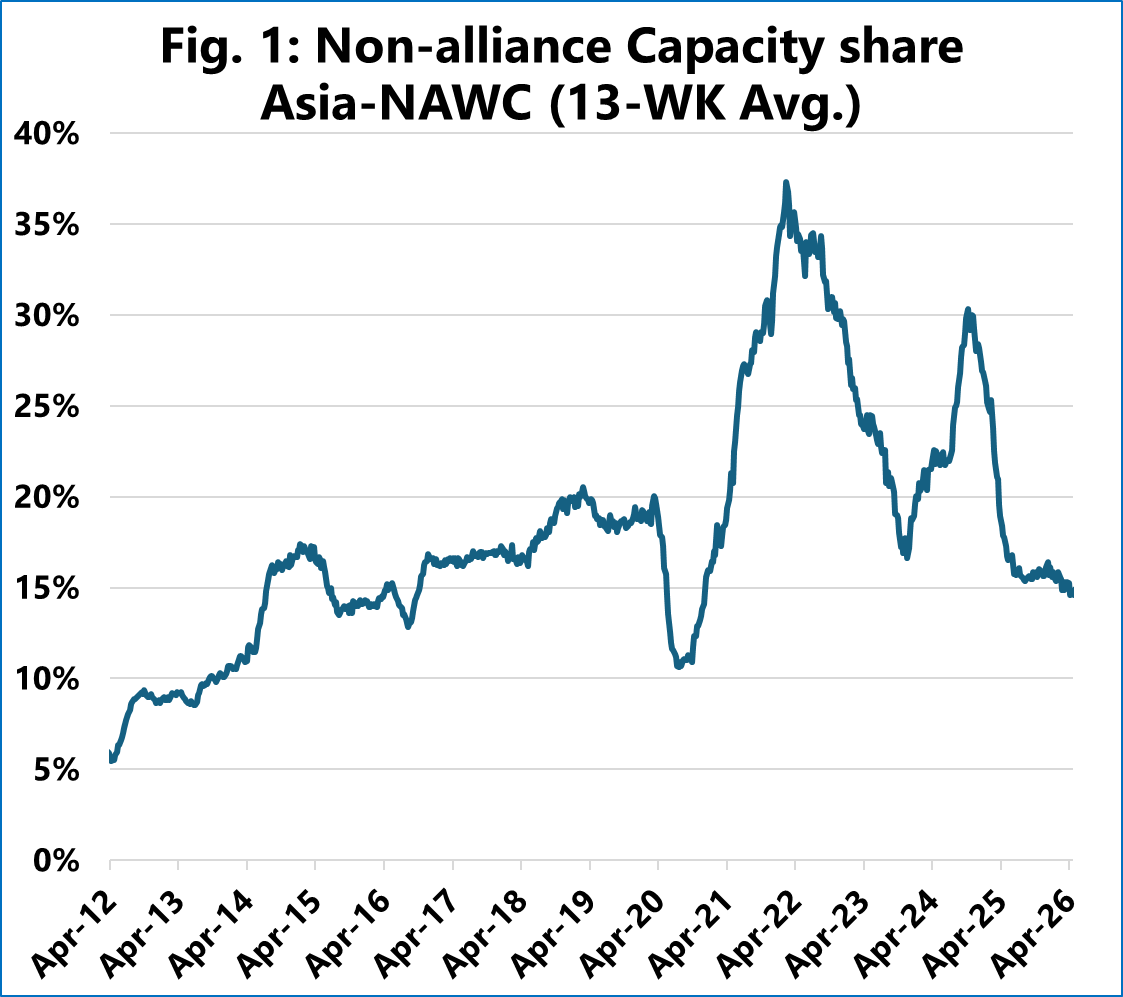
Sea‑Intelligence’s long‑term dataset tracks Asia–NAWC non‑alliance capacity over 14 years using a 13‑week rolling average to account for short-term volatility. The historical spikes during periods of market turmoil clearly demonstrate that the barriers to entry for non‑alliance services are relatively low.
However, Sea-Intelligence said the latest figures indicate a continued contraction with the capacity share of non‑alliance services declining steadily to a 10‑year low, over the past year, excluding a brief withdrawal period at the immediate onset of the pandemic.
Based on current carrier deployment plans, non‑alliance services are projected to fall below 15% of total capacity in the coming weeks.
Sea-Intelligence said the primary driver of this variability is the prevailing freight rate environment.
"Historical data shows a clear pattern: high spot rates lead to large injections of new non‑alliance capacity, while low rates prompt rapid withdrawals. Our analysis reveals a strong 79% correlation between spot rate levels and non‑alliance capacity, featuring an 18‑week delay,” said Alan Murphy, CEO of Sea‑Intelligence.
The analysis added that, ultimately, this structural elasticity demonstrates that competition remains highly active on the Transpacific trade. Independent carriers are effectively using their agility to scale their presence dynamically, entering and exiting the market in direct response to the economic viability dictated by spot rates.