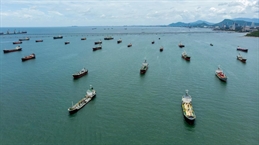
Iran's seizure of two MSC container ships in the Strait of Hormuz has prompted Xeneta to warn that Tehran is "weaponizing trade," as escalating maritime tensions threaten one of the world's most critical shipping lanes.
Iran's Islamic Revolutionary Guard Corps (IRGC) reportedly seized the MSC Francesca (11,660 TEU) and MSC Epaminondas (6,690 TEU) while they were transiting eastbound through the Strait of Hormuz, just hours after the U.S. and Iran announced an extension of their ceasefire.
Peter Sand, chief analyst at Xeneta, called ongoing blockades and attacks on commercial shipping in the Strait of Hormuz 'the weaponization of trade'. He noted that the incident underscores that despite diplomatic developments, "there is no safe and free passage through the Strait of Hormuz."
"The extended ceasefire can be seen as a positive step, but if it brings a calming of conflict in the skies, that has not reached the water because there is no safe and free passage through the Strait of Hormuz," Sand said.
"This is the weaponization of trade, with both sides recognizing the pain they can inflict with a bottleneck in the Strait of Hormuz."
The seized vessels were on eastbound voyages and two of six MSC ships which transited the Strait of Hormuz over the weekend while switching off AIS transponders, with the remaining four reaching safer waters.
The Strait of Hormuz—through which roughly 20% of global oil supply and significant container traffic normally flows—has seen severe disruption since hostilities intensified earlier this year.
Strait of Hormuz transits were increasing
Xeneta noted data showing Saturday marked the highest number of transits through the Strait of Hormuz since the escalation of conflict at the end of February.
A daily average of around 14 merchant ships have passed through the Strait of Hormuz in the past four weeks, but this is only 10% of normal transits.
While vessel transits had begun to recover, with as many as 43 merchant ships recorded on April 20, this remains only about 10% of normal traffic levels.
Sand noted that even when the strait appears open, conditions remain unstable and dangerous for seafarers, ships, and cargo.
"The lowest number of transits was mid-March, but since then it has been gradually increasing despite the blockades, which have been leaky from the start. Saturday saw a post-conflict high of 43 transits, including 10 container ships, possibly in response to increased hopes the Strait was re-opening," he said.
"However, the latest seizures make clear, even an 'open' Strait of Hormuz is not a safe Strait of Hormuz for seafarers, ships and cargo."
Sand warned the ceasefire will not allow a stabilization of ocean trade until there is greater reassurance over risk.
"The fact we have seen ships still transit the region throughout the conflict, even in small numbers, shows ship owners and operators want to keep maritime supply chains moving, but unfortunately there is no such thing as free navigation of the critical Strait of Hormuz."
"What we saw over the weekend was a spike in transits, but numbers are down again, and will remain down until we have real, trustworthy intelligence and communication to allow ships to operate in a safe manner."
The seized MSC vessels were among six that attempted passage over the weekend, reportedly switching off AIS transponders until reaching safer waters.
Freight rates start to ease
Meanwhile, Sand outlined more positive news for shippers in terms of the operational and financial impact of the conflict on supply chains, with alternative routing into the Middle East now established and freight rates starting to ease.
Average ocean container shipping spot rates from China to Jeddah – a key land bridge set up to connect Middle East destinations cut off by the de facto closure of the Strait of Hormuz – are up 63% since the escalation of conflict on 28 February. However, they have fallen 11% during April to stand at US$4,969 per FEU (40ft container).
"We see the first signs of freight rates coming down from the rapid rise in the aftermath of conflict. In Jeddah – one of the go-to alternative ports for shippers – we see inevitable port congestion caused by the land bridge bottleneck, but we also see that rates have spiked and are starting to ease," he said.
"This shows the workarounds are functioning for food and essential cargo into Middle East, but land bridges are constrained in terms of what kind and volume of goods they can handle, so shippers are still managing severe supply chain disruption," Sand added.