Ocean freight rates remain elevated on higher fuel costs linked to the Strait of Hormuz closure, but they are still far below the dramatic spikes seen during the Red Sea crisis and the trade‑war frontloading surge, according to new data from Freightos.
Container prices typically bottom out during the post‑Lunar New Year lull, yet this year they remain unusually firm. “Even with this pressure, rates are well below spikes caused by recent disruptions like the Red Sea crisis and trade war frontloading,” said Judah Levine, head of research at Freightos.
Asia–Europe rates slipped 3% last week, with North Europe prices at US$2,668/FEU, just 8% above pre‑war levels, and Mediterranean rates at US$3,527/FEU, now 3% lower than in late February.
Freightos noted that carriers have begun cancelling planned GRIs and announcing more blank sailings as demand remains soft. Levine said that while war‑related costs are keeping rates from falling further, “rate increase attempts have not succeeded in keeping prices much above their pre‑war baselines.”
(Source: Freightos)
Even so, Asia–Europe prices remain more than 15% higher year‑on‑year and more than 50% above October levels, the last major low‑demand period.
On the transpacific, carriers have been more successful in holding the line on
pricing. West Coast rates rose slightly to US$2,675/FEU, up 45% since the start of the war and nearly 90% above October lows. East Coast prices, just under US$4,000/FEU, are 30% higher than pre‑war levels and 30% above October.
But despite these increases, the combination of weak demand, ample capacity, and easing fuel prices has kept rates from reaching the full levels of announced GRIs and surcharges.
Peak season in June or July could bring the next significant rate push, though some analysts warn that war‑driven consumer cost pressures may dampen demand.
Meanwhile, container flows to and from Gulf states continue via alternative routes established after the Strait of Hormuz closure. Lower volumes have not prevented strain on the network, with Maersk reporting challenges for Gulf export containers. Gemini is adding capacity to Jeddah as import delays and high costs persist.
Air cargo: fuel‑driven cancellations but capacity stabilizing
In air freight, rising jet fuel costs have prompted more carriers to cut flights. Lufthansa will eliminate 20,000 CityLine short‑haul flights through October, while KLM will cancel some domestic services. United Airlines has introduced a market disruption fee for cargo bookings.
Fuel supply is tightening in Southeast Asia, with K+N adding fueling stops in China before flying to the region. EU officials have also discussed potential jet fuel shortages and may consider a sharing mechanism if conditions worsen.
Despite these pressures, global air cargo capacity—after a sharp drop in March—has recovered to within a single‑digit deficit of pre‑war levels as Middle East carriers restore operations and others shift capacity to alternative Asia–Europe routes.
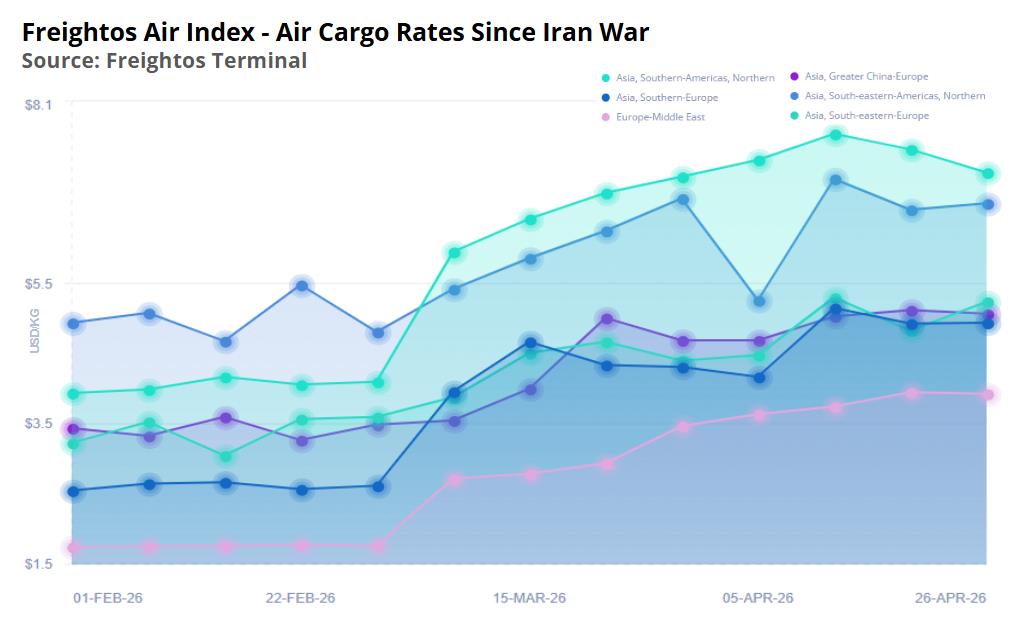
These additions, along with recent modest declines in jet fuel prices, are helping stabilize airfreight rates. The Freightos Air Index remains about 30% higher than before the war and year‑on‑year, but has held steady since early April.
China–Europe rates dipped slightly to US$5.07/kg, China–North America fell to US$6.40/kg, and South Asia–Europe eased 1% to US$4.94/kg. Southeast Asia–Europe rose 9% to US$5.24/kg, still just below its year‑to‑date high.