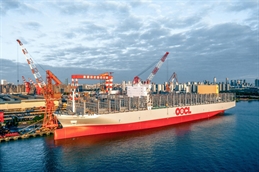
OOCL has outlined its strategic focus for 2026, eyeing to expand its fleet, accelerate investment in emerging markets, and deepen its cooperation with COSCO SHIPPING Lines—after reporting lower profit for 2025. The Hong Kong-headquartered shipping line said it is prioritising flexible, forward‑looking management to navigate volatile trade patterns and build a more balanced global network.
OOCL's parent company, Orient Overseas (International) Ltd., posted 2025 group revenue of US$9.72 billion, down from US$10.70 billion in 2024, while profit attributable to equity holders fell to US$1.51 billion, a sharp decline from US$2.58 billion the previous year.
Operating profit for the year reached US$1.54 billion, and EBITDA totalled US$2.54 billion, reflecting the impact of normalizing freight markets and softer margins across major trades.
Meanwhile, container liftings rose modestly to 7.9 million TEU, up from 7.6 million TEU in 2024, but the company noted that fluctuating cargo volumes and freight rates—particularly on the transpacific—continued to pressure earnings.
"In 2025, the global economy moved unpredictably amid shifting and uncertain policy environments. Tariff measures and trade tensions continued to weigh heavily on the container shipping industry, most notably on the transpacific trade, driving sharp fluctuations in both cargo volumes and freight rates. At the same time, policy adjustments and front‑loading disrupted the usual post Lunar New Year seasonal patterns. Heightened expectations of strong profit margins intensified competition on certain routes, amplifying market volatility and creating significant operational challenges for carriers, shippers, and freight forwarders," OOCL said.
"Entering November, tariffs and port charges imposed under the USTR 301 investigation were suspended. Although uncertainty persisted over whether tariffs would be reinstated, the one-year suspension offered temporary relief to market sentiment. As the traditional year‑end peak season approached, the container shipping market began to recover gradually."
It noted that although global economic growth slowed in 2025, several emerging markets, such as Africa, South Asia, and Southeast Asia, continued to show strong growth momentum — which may have been driven by shifts in trade patterns that boosted local trade, or by domestic economic expansion stimulating local demand.
"It is also possible that spillover effects from other markets simply require more time to materialise. Regardless of the reason, we have seen carriers seize this opportunity to accelerate the deployment and adjustment of their service networks."
In a rapidly changing market environment, OOCL said it remained firmly committed to implementing proactive, flexible, and forward‑looking management strategies to address uncertainties. "While strengthening our East-West service networks, we are also adapting to shifts in global trade patterns, seizing new growth opportunities, accelerating investment in emerging markets, and striving to achieve a more balanced global presence to mitigate risks arising from individual regional markets."
Against this backdrop, OOCL is leaning heavily on fleet expansion to support its 2026 strategy.
The shipping line completed delivery of nine 16,828‑TEU vessels in 2025, strengthening its transpacific capacity and enabling the reinstatement of the LL3 Asia–Europe service, previously suspended due to vessel shortages.
Additional ships are scheduled for delivery this year, including 24,000‑TEU methanol dual‑fuel vessels and 13,580‑TEU conventionally fueled ships chartered from Seaspan subsidiaries. OOCL said the dual‑fuel ships mark a key step in its decarbonisation efforts.
"The addition of these vessels will support the continued expansion and upgrading of our fleet, enabling us to build a more efficient, environmentally friendly, intelligent, and wider‑coverage service network for our customers. Moreover, the delivery of the dual fuel vessels marks an important milestone in OOCL's decarbonisation journey," it said.
OOCL also highlighted emerging markets as a priority for 2026, citing the need to diversify beyond traditional East–West trades amid shifting global demand patterns.
It said it is increasing investment in developing regions to reduce exposure to individual markets and improve network resilience.
OOCL's cooperation with COSCO SHIPPING Lines remains another pillar of its strategy. It said that the dual‑brand approach has delivered cost and risk‑management benefits in recent years, and it expects those synergies to continue supporting operations in 2026.
Beyond vessel deployment, OOCL is expanding its presence across the logistics chain, offering services such as order processing, cargo management, warehousing, and distribution.
It said that these initiatives are aimed at building a more integrated, digitalised supply chain offering for customers.
"We are accelerating our vertical expansion of the supply chain by offering customised solutions such as international order processing, cargo management, warehousing, and distribution services. These efforts enable us to build an end‑to‑end intelligent and digitalised supply chain that delivers high‑value services for our customers, further fulfilling our Customer Focus commitment," OOCL said.
It added that digitalisation has become "integral" to its services and operations, serving as a powerful tool to strengthen cost control, enhance management efficiency and user experience, and maintain our competitiveness.
"Through our collaboration with GSBN, we are also working with other stakeholders to advance the development of a fully digitalised supply chain and foster a smart and healthy global trade ecosystem," the shipping line added.
Despite the weaker financial performance in 2025, OOCL said it enters 2026 focused on capacity renewal, market diversification, and operational discipline as carriers brace for another year of geopolitical uncertainty and uneven trade flows.
"As we entered 2026, some carriers have at one point routed certain services or vessels through the Red Sea, and new vessel deliveries continue to increase. Concerns over excess capacity have resurfaced, yet the charter market remains exceptionally tight with vessels in extremely short supply, and changes in the Middle East situation have added further uncertainty to future market developments," OOCL said, noting that effective capacity management therefore remains a central focus for the industry.
"Meanwhile, geopolitical developments are occurring with increasing frequency, and where any single event may take effect instantly and create far‑reaching ripple impacts, it has become increasingly difficult to forecast market trends with precision. The only prudent course is to stay focused on our own fundamentals, act with caution, adapt to evolving conditions, and respond proactively."